The role of fleet management in the waste management industry

In the collection of articles on the Logiico blog about fleet management in various industries, today we turn to the waste industry. An industry that plays a significant role in reducing environmental pollution and is considered one of the important and influential jobs. In this week's article, we examine the importance of fleet management for waste management businesses and explore the impact of fleet management software in this industry from different perspectives.
A Look at Waste Management in Iran
In the field of municipal waste, Iran produces more than 10 million tons of waste annually. The average production of municipal waste is 240 kilograms per year, with a large portion attributed to the capital. An interesting statistic about Tehran's waste production is 450 kilos of waste per person!
The National Waste Management Law of 2004 and the five-year urban waste management plan form the legal and strategic foundations of waste management in Iran. Currently, the waste management law is under review, and it remains to be seen what new priorities the legislator will consider for inclusion in the waste management law.
Alongside content review, the main challenge lies in implementing the initial laws. Currently, the implementation of laws is facing issues due to a lack of financial and human resources and insufficient knowledge in waste management among the competent authorities. Educational actions and consulting and retraining services at the national and local levels can help build capacity in the relevant authorities.
In an article on the status of waste management in Iran and other countries, the features of waste management in Iran were listed as follows:
- Lack of comprehensive and operational plans
- Absence of monitoring systems
- Lack of coordination between different sectors
- Absence of sanitary systems for collecting dry waste
- Recycling is not economical due to energy subsidies and others
These were some of the points mentioned in the article. In fact, considering that some countries in the world have appropriate systems and mechanisms, using the experiences of these countries will improve the quality and performance of the recycling and waste management process.
Next, we intend to examine the impact of fleet management and the organization of waste fleets in reducing costs and improving performance in waste management processes.
The Role of Fleet Management in Waste Management
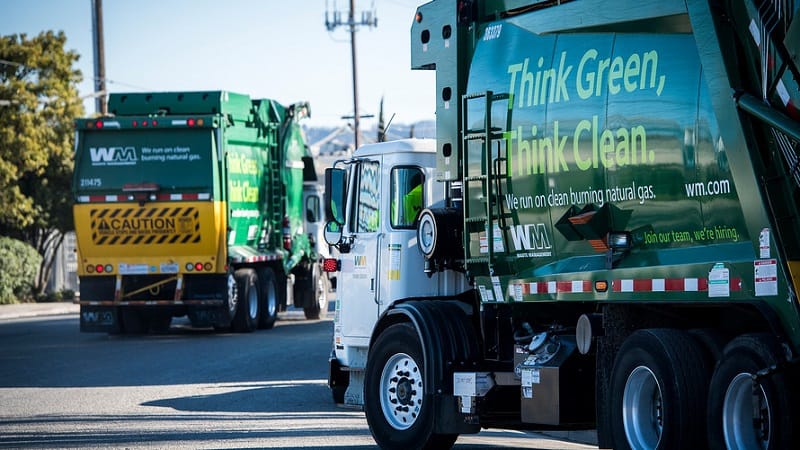
In articles on fleet management in the oil and gas industry and the pharmaceutical distribution industry, we examined the general features of fleet management software in industries as follows:
- Direct and real-time communication with the management unit
- Receiving information online
- Driver behavior analysis
- Reducing fleet maintenance and repair costs
- Evaluation and reporting of fleet performance
Now we will examine the mentioned points in the waste management industry and their importance.
Direct and Real-Time Communication
Regarding the importance of receiving direct and online information, we can examine a case study. The Bluewater Recycling Association located in Canada, a recycling and waste collection company, concluded that information and communication should flow between drivers and the support team. BRA saw the advantage of this in reducing friction in communication with drivers and completing missions, and believed that this would create more flexibility in the team.
Driver Behavior Analysis
According to statistics from the country's traffic police, the main reason for accidents is driver inattention and exceeding safe speed limits. These statistics show that controlling driver behavior and informing management in this area can have a significant impact on reducing accidents.
In this regard, by examining one of the best case studies, we reach interesting results. The American company Kimble Recycling & Disposal considers fleet safety its top priority.
The managers of this company believe that transparency and awareness of driver activities during missions, in addition to reducing accidents, create a positive brand image in the community. The logistics and fleet management team of this company, to be aware of their drivers' behavior, uses fleet management software to access information such as safe speed, stopping points, unnecessary braking, etc., and with this information, they can manage their fleet in the best possible way.
Reducing Fleet Maintenance and Repair Costs

In an article titled Scrap Fleet, Frustrated Manager, we mentioned the costs required for fleet maintenance and repair. To increase efficiency in a process, it is necessary to reduce friction along the way and increase transparency and smoother control.
Here, too, we examine one of the best case studies, the company Indiana Waste Service. This company discovered that a large portion of their operating costs was related to the maintenance and repair of their fleet, and they were paying significant annual costs for fleet repairs, requiring an alternative plan to reduce their maintenance costs.
The operational team of this organization, by monitoring missions and receiving reports from missions and analyzing their drivers' behavior, managed to reduce their repair costs over a few months.
As you observed in this case study, reducing maintenance and repair costs depends on having real-time and direct information about activities and missions, awareness of driver behavior, and analysis of mission reports.
Evaluation and Reporting of Fleet Performance
Having a platform for receiving reports and evaluating fleet and driver performance allows you to better identify and resolve obstacles and factors that disrupt your processes.
In addition to the mentioned points, mission reporting can provide a better view of the future for making strategic and tactical decisions for your business, and using the obtained information, you can achieve your organization's defined goals.