Introducing some challenges in delivery management

Today, with the expansion of digital businesses and the diversification of purchasing methods, managing product delivery has become more complex, especially in last-mile delivery. Interestingly, in 2019 alone, internet users were online for over 1.2 billion years. This figure is truly astonishing! It indicates a shift in the consumption pattern of a large percentage of customers and leads organizations to change their strategies towards modern and optimized logistics methods.
Given the presented figures and the growth in online shopping, the logistics industry has also seen significant expansion, which has led to more and sometimes newer challenges. In this article, we have tried to examine the areas that have experienced the most challenges.
The areas that create the main challenges for employers or organizations include:
- Predicting the best delivery process
- Inventory management
- Hiring reliable couriers
- Vehicle tracking
- Driver or courier performance
- Customer satisfaction
- Managing unforeseen issues
- Improving the payment process
Now that we are familiar with the main areas of challenges, it is better to provide explanations about the types of their challenges, although some of them may seem simple at first glance, they are still considered important and costly issues for organizations.
Predicting the Best Delivery Process
One of the biggest challenges for small businesses in delivering same-day goods is the difficulty in predicting how much inventory of orders should be ready. With this prediction, you will have more precise planning. If a company has a small number of employees, doing this without predicting orders will be more difficult.
Hiring a team for phone support for couriers involves costs. Also, using companies with couriers can be expensive, especially for businesses that are just starting. The profit from products must be high enough to cover daily delivery costs.
Inventory Management
If the inventory system is not regularly updated, purchasing or ordering new goods will face problems. For daily delivery, the number of inventory in the warehouse and shipments must be trackable, which requires continuously keeping the inventory updated online. Knowing the status of shipped and warehouse inventory can be done through appropriate software systems.
Hiring Reliable Couriers
For same-day delivery, a business must have reliable couriers who are familiar with the work methods and delivery needs and can provide appropriate feedback to their manager. Knowing the courier's interaction with the customer or their behavior during delivery or knowing their exact movement status in fulfilling the assigned task provides more assurance for the manager.
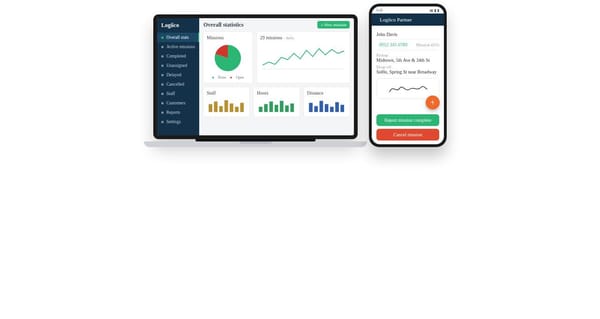
With systems like Logiico's fleet management software designed to manage employees outside the company, a more comprehensive view of these employees' activities can be obtained.
Customers expect to receive goods at the specified time and without defects. By knowing the errors and problems in delivery, they can be gradually resolved.
Delivery at the Specified Time
Customers who place orders expect their shipments to reach them at a specific time - this is key to providing this vital service. If delivery takes too long, customers may turn to another store for their next order. To avoid disappointing the customer, a reliable tracking program can give customers full assurance of receiving their shipments on time.
Tracking the Courier or Vehicle
Tracking the vehicle is considered the first and most basic monitoring tool for logistics managers, but it's interesting to know that this initial and basic aspect is also accompanied by many challenges and problems in many organizations. After reviewing several credible sources, we were able to categorize these challenges to help you become more familiar with them. But what are these challenges?
- Selecting the appropriate system
- Implementation in the organization and alignment with organizational processes
- Training drivers and colleagues in the organization for better compatibility with the system
- Maintenance and support of the tracking system
- Reporting and proper use of collected data
Driver or Courier Performance
One of the main challenges in logistics and transportation is measuring performance initially and then improving the courier/driver's performance based on the measured items, which is evaluated with specific indicators. Some of the most important indicators include:
- Number of orders completed per day
- Number of stops
- Number of active days
- Customer satisfaction with interaction and behavior with the driver as your brand ambassador
Of course, it should be noted that each logistics company can define indicators for its logistics and drivers to assess the driver or courier's performance based on them. For example, in companies active in the distribution industry, an indicator called the number of returns is considered a performance indicator for the distributor, which can find appropriate enforcement with coordination with the drivers' payroll system.
Customer Satisfaction
In the discussion of product delivery, one of the factors that causes customer dissatisfaction is not delivering the product on time, and this shows a company's ability to manage logistics and supply chain. According to the Optimum Design blog, 97% of customers believe that timely arrival of the courier greatly affects their overall satisfaction; however, the noteworthy point is that if you inform the customer that a problem has occurred and the courier may not arrive at the scheduled time, this message can lead to customer appreciation and can reduce dissatisfaction or even increase customer satisfaction! In the discussion of product delivery to customers, generally, the following factors can have a significant impact:
- Matching the customer's order with the received product
- Delivering the product or order in good condition
- Delivering the product at the time committed to the customer
Managing Unforeseen Issues
During any project, relatively small issues may arise that are unexpected and affect the final goal; for example, in product delivery, incidents such as a vehicle tire puncture, vehicle accident, or even the customer not being present at the delivery location may occur, which were not planned for and can significantly impact the outcome; therefore, it can be concluded that managing such unforeseen issues is of high importance, and in these cases, the organization must be able to take the best action with crisis management, because improper management of these issues usually affects the entire supply chain in a chain reaction and takes them out of the set schedule and timing.
Improving the Payment Process
In the past, the payment method was solely in-person and with cash; however, today, with the diversification of payment methods, organizations must enable various payment methods to avoid wasting the courier's time at the location and to create customer confidence. For example, during the COVID-19 pandemic, people are less inclined to pay in cash; therefore, the absence of an online payment gateway on the site, not having a card reader, and not training the courier according to various payment methods can disrupt the organization's process.
Conclusion
Although order delivery management (DMS) systems, courier monitoring, and performance evaluation have undergone significant changes compared to the past, these challenges still manifest at other levels; for example, tracking couriers and drivers with modern tools is much simpler and more stable than before, but the way managers use reports from these systems and analyze the resulting data remains a major challenge and concern for employers and organizations.
Certainly, the challenges of this topic are not limited to the mentioned points, and as organizations become more competitive, even the smallest weaknesses can become problematic. Solving all these challenges does not happen all at once or miraculously; rather, it requires defining processes and systems in the mentioned areas. Additionally, having the right tools to cover these areas is recommended. Tools that help you to:
- Have more stable and better tracking and monitoring of your fleet
- Automatically assess your drivers' performance using information management systems
- Deliver more orders to customers in less time using fleet planning and routing modules with smart algorithms, while reducing costs and increasing customer satisfaction
- Use collected data to set specific scenarios for unforeseen events
These are some of the benefits of having IT-based tools in logistics organizations, transportation, online stores, and more, which can assist you.
In Iran, there are numerous tools available in the market for fleet management and goods delivery management or courier management, but one of the most comprehensive ones that covers almost all the above areas and has recently unveiled its planning module with smart algorithms is the Logico software, which can be a suitable choice for your organization.