Will the Hyperloop change the future of the supply chain?

Technologies that add new color and flair to the industry day by day. Robotic hands, cargo robots (examples of robots used in Alibaba and Amazon warehousing shared on the Logiico Aparat channel), self-driving cars, hyperloops, and the like have all opened new gateways to the growth and development of various industries, including supply chain and logistics.
One of the technologies we want to talk about today is hyperloops. Gadgets that travel at speeds exceeding 1200 kilometers per hour, covering long distances in just a few hours without any issues. Let's start by exploring what hyperloops are and then look at their impact on the supply chain. So stay with us.
Hyperloop: The Fastest Transportation System in the World
Humans have always been fascinated by speed and acceleration. This can be clearly seen in even the smallest inventions and discoveries. Most optimizations in transportation systems are often based on increasing speed and reducing travel time.
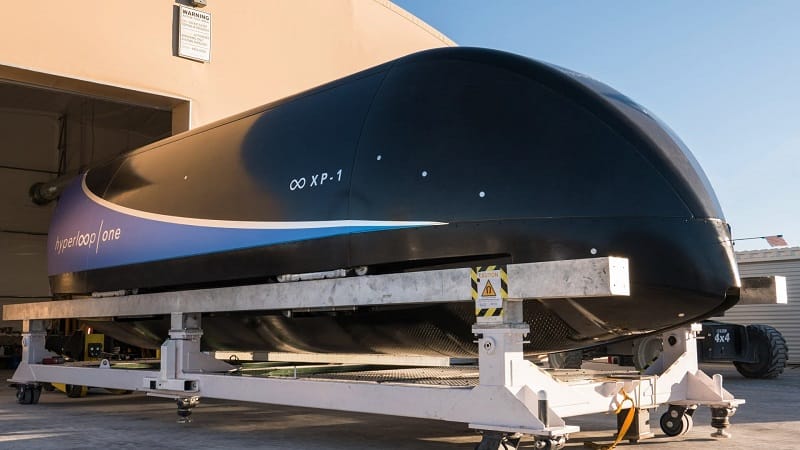
The hyperloop is no exception to this rule. A human-made creation to satisfy the love for speed! Elon Musk, the founder of companies like Tesla Motors and SolarCity, proposed the idea of hyperloops. In this type of transportation, capsules are placed inside tubes where a vacuum environment is maintained to eliminate friction, reaching speeds of up to 1220 kilometers per hour. At this speed, one can travel from Los Angeles to San Francisco in just 35 minutes.
The hyperloop moves using air pressure that is applied from the back of the vehicle and expelled from its lower outlets. However, there is still a long way to go before it becomes operational and commercially viable, as the current cost of implementation is 70 billion dollars, which needs to be reduced, and there are many environmental obstacles in its path. For example, its noise pollution is currently so high that it cannot be used near residential areas.
Hyperloop Changes the Future of Logistics
The creation of routes where transportation is carried out via hyperloops is currently being implemented worldwide. The first instance began in 2015. In the Middle East, Arab countries like the UAE are implementing projects to shorten the distance between their capitals. For example, the current distance between Dubai and Riyadh (the capital of Saudi Arabia), which is 1120 kilometers, typically takes 10 hours by car. This distance is reduced to 47 minutes using hyperloops.
So the first benefit and advantage of this technology can be seen as a significant reduction in time thanks to their high speed.
Speed
Port Technology magazine, in an interview with Ryan Kelly, stated that hyperloops can combine the speed and safety of air transport in ground logistics. Thus, with significantly lower costs in the long run, the speed of goods transportation can be dramatically increased. This increase in transportation speed, in addition to increasing the number of shipments per day, ensures a much more reasonable level of safety and cost compared to ground transportation.
Sustainability
The ability to quickly send goods over long distances with high security and performance turns the tables in the supply chain game. Among the advantages of adopting hyperloop technology in logistics and supply chain is the creation of sustainability in all areas. This sustainability can be seen in terms of reducing carbon dioxide emissions and helping to preserve the environment, reducing fossil fuel consumption, and more.
The capacities available in the use of smart logistics are vast and beyond imagination. Many believe that the emergence of this technology will disrupt many equations in this chain. However, the important point is that the fourth wave of technology is gaining momentum day by day, and it is necessary to align with this wave through smart strategies.